
I am the founder and CEO of Neural Machines Inc., where we build on-premises and edge AI systems for businesses, helping them achieve digital sovereignty to boost productivity, efficiency, and privacy. I am also a reinforcement learning specialist with a focus on developing intelligent agents and optimizing decision-making processes in multi-agent contexts. Beyond engineering, I write about the philosophical and societal implications of AI (see my blog).
Technology Stack
| Languages | French, English, Python, Rust, Bash |
| ML/AI development | PyTorch, JAX |
| AI Engineering | LangChain, Ollama, vLLM, airLLM |
| DevOps | Docker, Git |
Education
PhD in Mathematics, Polytechnique Montreal, QC, Canada
Msc in Economics, Université de Montreal, QC, Canada
B.A in Mathematics, Université Côte d’Azur, Nice, France
Open Source Projects
Here are some software projects I’ve been working on. I believe sharing code helps everyone learn and build better tools together. My intention is to find a middle ground between vibe coding and scratch coding, as I build softwares in the that aim to streamline code production by packaging commonly used functionalities in deep learning project.
These projects mostly stem from problems I’ve encountered in my own research, and I hope they might be useful to others facing similar challenges. While they’re not perfect, I’ve tried to document them well and make them accessible to researchers and developers who might find them helpful.
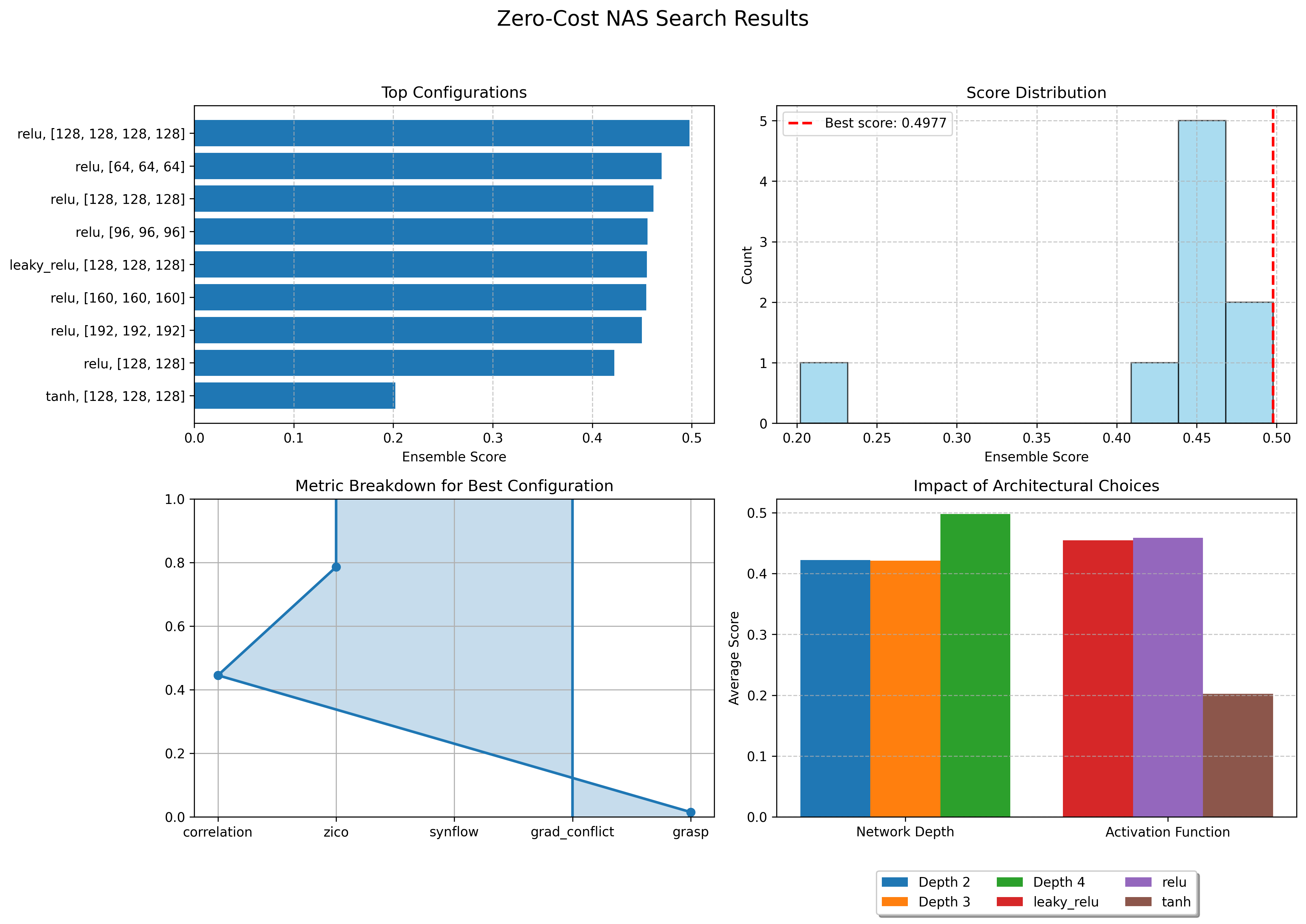
zcsearch: Zero Cost Search is a Python/PyTorch package that implements an ensemble score based on three well-established meta-algorithms for efficient (virtually zero computational cost) neural architecture search. It helps you build neural networks tailored to your problem. The package is easy to use, provides visualizations for model selection, and comes with extensive documentation. The final output is a PyTorch model, which can be wrapped for compatibility with ONNX and other frameworks.
To cite zcsearch:
@software{zcsearch,
  author = {Sadoune, Igor},
  title = {Zero-Cost-Search: A Python Package for Zero-Cost Neural Architecture Search},
  year = {2025},
  url = {https://github.com/IgorSadoune/zcsearch},
  version = {0.1.5},
  description = {A robust and zero-cost way to find neural architectures that fit your data.}
}neuralm: This is Python/PyTorch software for generating neural architectures from a simple YAML file. With neuralm you can produce highly complex models (e.g., transformers) and custom topologies. The final output is a PyTorch model, which can be wrapped for compatibility with ONNX and other frameworks.
Input YAML example for GANs:
model_type: gan
name: MyGAN
latent_size: 100
generator_layers:
  - type: linear
    in_features: 100
    out_features: 256
    is_first: true
  - type: relu
  - type: linear
    in_features: 256
    out_features: 512
  - type: relu
  - type: linear
    in_features: 512
    out_features: 784
  - type: sigmoid
discriminator_layers:
  - type: linear
    in_features: 784
    out_features: 512
  - type: leakyrelu
    negative_slope: 0.2
  - type: linear
    in_features: 512
    out_features: 256
  - type: leakyrelu
    negative_slope: 0.2
  - type: linear
    in_features: 256
    out_features: 1
  - type: sigmoid
To cite this software:
@software{neuralm,
  author = {Sadoune, Igor},
  title = {NeuralM: A Neural Network Model Builder},
  year = {2025},
  url = {https://github.com/IgorSadoune/neuralm},
  version = {0.1.0},
  description = {A flexible framework for building and training neural network models with YAML configuration.}
}
Research
At its core, my research grappled with a pivotal question: How can independent AI learners coevolve—and ultimately cooperate—within shared systems or environments? In an era increasingly shaped by AI, this inquiry transcends mere engineering; it sits at the heart of our collective trajectory as a civilization.
Technically, this pursuit lives at the intersection of generative AI, multi-agent reinforcement learning, and algorithmic game theory. My favorite testing ground? Economics—a microcosm of societal structures, offering both a mirror to human behavior and a sandbox for probing emergent collaboration.
| Authors | Igor Sadoune |
| Year | 2024 |
| Access | Full Text |
| Keywords | Deep Generative Modeling, Multiagent Reinforcement Learning, Algorithmic Game Theory |
| Abstract | A central problem in the study of multi-agent systems concerns elucidating how selfish agents can collaborate and exhibit group intelligence within large-scale decision-making contexts. This issue is particularly reflected in scenarios characterized by a tension between individual and collective welfare. From a methodological perspective, game theory seamlessly integrates algorithmic learning, providing fertile grounds for the study of tacit coordination among artificial learners in non-cooperative settings. This thesis explores the intricate dynamics of transitioning from non-Pareto Nash Equilibria to Pareto-Optimal strategies in the context of a minimum price-ruled coordination game. This research is anchored in three comprehensive studies, each addressing unique challenges and opportunities in agent-based computational |
simulations and in the study of emergent algorithmic behavior.
First, we introduce a meta-algorithm for simulating realistic synthetic multi-level auction data. To overcome the challenges inherent to the high-cardinality, multi-level, and discrete nature of such structures, we employ a hierarchical deep learning approach based on generative adversarial learning and the proposed BidNet, a predictor of conditional bid distributions based on underlying features. This advancement aids in developing and testing large-scale models for agent-based simulations.
Second, we introduce the Minimum Price Markov Game (MPMG), which under the condition of homogeneity, extends the Prisoner’s Dilemma to a stochastic game. The MPMG is then populated with Multi-Agent Reinforcement Learning (MARL) agents to examine the robustness of the minimum price rule against collusion when coordination is not engineered. Our findings reveal that uninformed agents coordinate more easily towards Pareto Optimal outcomes than their sophisticated counterparts, meaning that tacit coordination, or tacit collusion, can occur accidentally in such settings.
Finally, we devise the Strategic Equilibrium Policy Gradient (SEPG), a MARL method that aims to foster tacit coordination in non-cooperative settings without relying on direct communication mechanisms. The SEPG is an actor-critic policy gradient algorithm that combines planning with adaptive online learning, enabling agents to achieve Pareto Optimal strategies in the MPMG. We show that SEPG agents can achieve collusion while demonstrating rational behaviors. |
@article{Sadoune2024,
  title={Algorithmic and Tacit Coordination Among Artificial Learners},
  author={Igor Sadoune},
  journal={Ph.D Thesis},
  year={2024},
  url={https://publications.polymtl.ca/59212/}
}| Authors | Igor Sadoune, Marcelin Joanis, Andrea Lodi |
| Year | 2024 |
| Publisher | Computational Economics |
| Access | arXiv |
| Keywords | Deep Generative Modeling, Multilevel Discrete Data, Auction Data Simulation |
| Abstract | We present a deep learning solution to address the challenges of simulating realistic synthetic first-price sealed-bid auction data. The complexities encountered in this type of auction data include high-cardinality discrete feature spaces and a multilevel structure arising from multiple bids associated with a single auction instance. Our methodology combines deep generative modeling (DGM) with an artificial learner that predicts the conditional bid distribution based on auction characteristics, contributing to advancements in simulation-based research. This approach lays the groundwork for creating realistic auction environments suitable for agent-based learning and modeling applications. Our contribution is twofold: we introduce a comprehensive methodology for simulating multilevel discrete auction data, and we underscore the potential of DGM as a powerful instrument for refining simulation techniques and fostering the development of economic models grounded in generative AI. |
@article{Sadoune2024BidNet,
  title={Deep Generative Simulation of Multilevel Discrete Auction Data},
  author={Igor Sadoune and Marcelin Joanis and Andrea Lodi},
  journal={Computational Economics},
  year={2024},
  note={arXiv preprint arXiv:2207.12255},
  url={https://arxiv.org/abs/2207.12255}
}| Authors | Igor Sadoune, Marcelin Joanis, Andrea Lodi |
| Year | 2025 |
| Publisher | submitted |
| Access | arXiv |
| Keywords | Algorithmic Game Theory, Multiagent Reinforcement Learning, Algorithmic Coordination |
| Abstract | This paper introduces the Minimum Price Markov Game (MPMG), a theoretical model that reasonably approximates real-world first-price markets following the minimum price rule, such as public auctions. The goal is to provide researchers and practitioners with a framework to study market fairness and regulation in both digitized and non-digitized public procurement processes, amid growing concerns about algorithmic collusion in online markets. Using multi-agent reinforcement learning-driven artificial agents, we demonstrate that (i) the MPMG is a reliable model for first-price market dynamics, (ii) the minimum price rule is generally resilient to non-engineered tacit coordination among rational actors, and (iii) when tacit coordination occurs, it relies heavily on self-reinforcing trends. These findings contribute to the ongoing debate about algorithmic pricing and its implications. |
@article{Sadoune2025MPMG,
  author = {Sadoune, Igor and Joanis, Marcelin and Lodi, Andrea},
  title = {Algorithmic Collusion and the Minimum Price Markov Game},
  journal = {Games and Economic Behavior},
  year = {2025},
  note = {submitted, \url{https://arxiv.org/abs/2407.03521}}
}| Authors | Igor Sadoune, Marcelin Joanis, Andrea Lodi |
| Year | 2025 |
| Publisher | submitted |
| Access | upcoming |
| Keywords | Multi-agent Reinforcement Learning, Tacit Coordination, Strategic Equilibrium Policy Gradient |
| Abstract | This paper introduces the Strategic Equilibrium Policy Gradient (SEPG), a multi-agent reinforcement learning approach designed to foster tacit coordination in coordination games, namely, competitive social dilemmas for which individual interests align with group welfare. The SEPG is implemented and tested on the Minimum Price Markov Game (MPMG), a dynamic coordination game that models first-price auctions governed by the minimum price rule. Unlike methods that rely on explicit mechanisms for cooperation such as centralized learning or communication, SEPG leverages a combination of pre-game planning and online adaptation to guide agents toward the Pareto equilibrium through implicit, or tacit, coordination. This study demonstrates that SEPG agents achieve robust tacit coordination in both homogeneous and heterogeneous scenarios, challenging existing MARL methods and highlighting the potential for tacit collusion in AI-driven markets. Our experiments reveal that SEPG encourages coordination among malicious actors while also promoting rational behavior in competitive settings. |
@unpublished{Sadoune2025SEPG,
  author = {Sadoune, Igor and Joanis, Marcelin and Lodi, Andrea},
  title = {Strategic Equilibrium Policy Gradient: On Learning Tacit Coordination},
  year = {2025},
  note = {working paper, forthcoming}
}